Profit-first budgeting for small business owners
Flip the formula: take profit and tax out the moment money arrives, then run the business on what is left. Here is the idea and a simple way to start.

The traditional formula is Sales − Expenses = Profit. It sounds logical, but it means profit is whatever is left after you spend, which is often nothing.
The profit-first idea, popularized by author Mike Michalowicz in his book Profit First, flips it: Sales − Profit = Expenses. You take profit out first, then run the business on what remains. The core point is behavioral: when money is in the account, it gets spent. When profit is already moved, you adapt your spending to fit.
How it works in practice
Open a few separate bank accounts (or sub-accounts) and move a percentage of every deposit into each:
- Income: where all revenue lands
- Profit: reward and safety net
- Owner pay: your salary
- Tax: set aside for tax bills
- Operating expenses: everything you spend to run the business
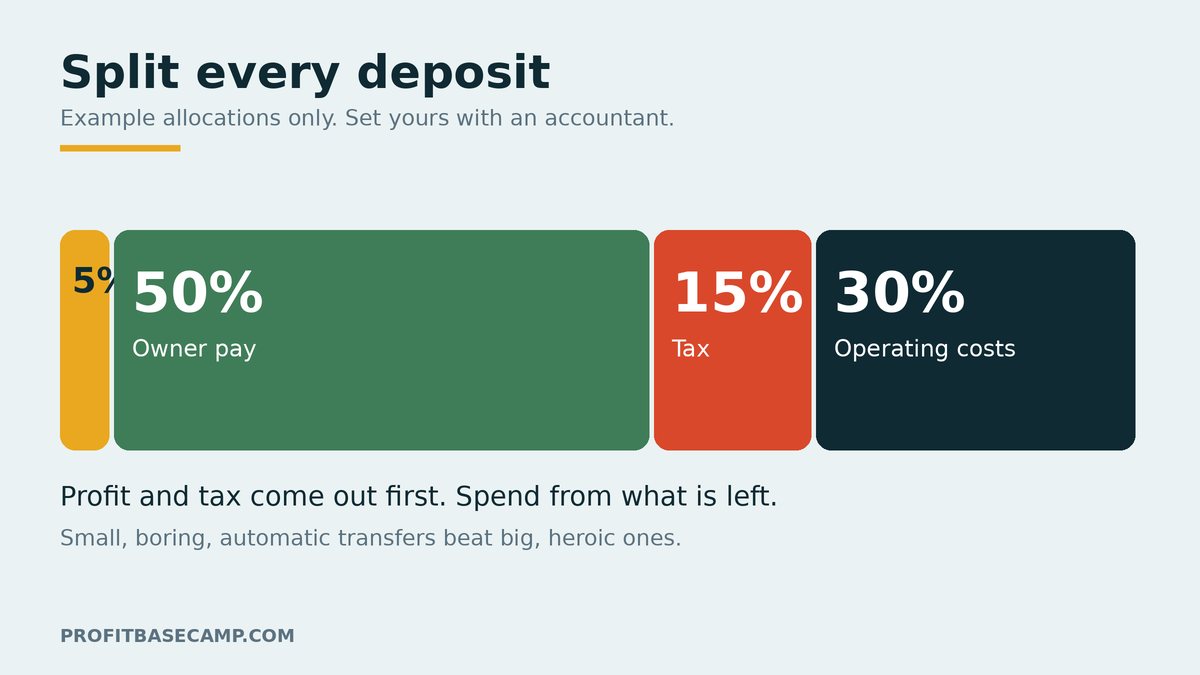
Those percentages are examples. Real targets vary by revenue and business type. The book offers suggested starting allocations, and an accountant who knows your situation can help you adapt them.
Start small
You do not need to copy a textbook split on day one. Start with this:
- Open a separate Profit account and a Tax account.
- Pick a starting percentage, even 1 to 5 percent for profit.
- Transfer on a fixed rhythm. Weekly or twice a month works for most.
- Raise the percentage every quarter by a point or two as it becomes comfortable.
Build the habit first. The amount matters less than the routine.
Add it to your weekly routine
Fold the transfers into your 20-minute weekly money meeting. The fourth block, profit, is exactly this: move profit and tax money first, then look at what is left to spend.
What to do when expenses do not fit
If your operating account cannot cover expenses after the transfers, you have a pricing or cost problem, not an accounting problem. Look at three levers:
- Raise prices. See how to raise prices without losing clients.
- Cut costs you would not choose again. Check your tool subscriptions.
- Change the offer to something more profitable per hour. See productize your service.
Use the margin and break-even calculators to see which lever moves most.
Where to learn more
The author shares articles and resources on his site at mikemichalowicz.com. The U.S. SBA and SCORE also offer free business mentoring and cash-flow guidance. Talk to an accountant about taxes in your area.
Educational content only, not financial or tax advice. Percentages shown are examples.
- Take profit and tax out first, then spend what remains.
- Use separate accounts and a fixed transfer rhythm.
- Start with small percentages and raise them gradually.
- If it does not fit, fix price, costs or the offer.
Get the Summit Brief
One idea, one tool and one number each week, plus the free First Profit Checklist.
Some links on ProfitBasecamp may be affiliate links. If you buy through them we may earn a commission at no extra cost to you. How we pick tools. This is educational content, not financial, legal or tax advice.